PrestaShop Alternatives 2026: Which Platform Really Fits You
PrestaShop alternatives compared: without expensive modules or compatibility issues after updates, but a well-maintained app store. With a clear recommendation.

Richard Roth
SEO & GEO Strategist
August 14, 2026
8 min read
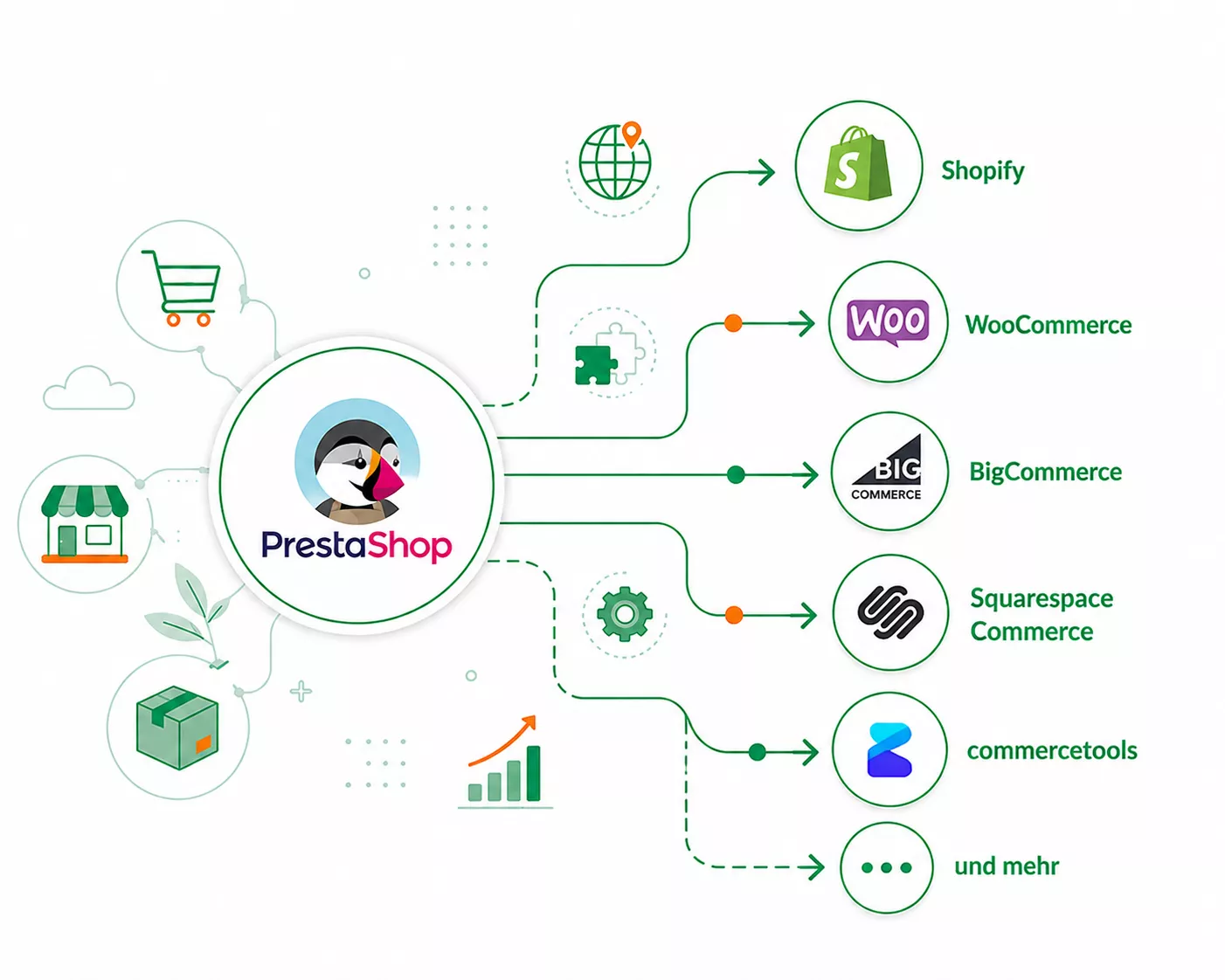
PrestaShop is free and flexible, but the real bill comes later: through expensive themes, paid modules and an operation that quickly stalls without a developer. Anyone who’s done that for a few years eventually looks for something with less upkeep.
Let’s look at the best PrestaShop alternatives: what they can do, where their limits are and which system really pays off for whom.
- • Shopify is the most obvious alternative for most PrestaShop shops: hosted, maintenance-free and without the constant module and update effort.
- • The biggest pain point with PrestaShop, according to user reviews, is the cost of themes and modules plus compatibility problems after updates.
- • WooCommerce is the alternative if you want to stay open source and content-driven, but you trade one maintenance load for the next.
- • Adobe Commerce is the exception upward: for very large, custom B2B, Shopify isn't automatically the best choice.
- • PrestaShop's strength stays the full control at low license cost. The price for it is the ongoing technical upkeep.
Why do merchants switch from PrestaShop?
The reason is rarely the system itself, but what piles up around it. PrestaShop is self-hosted and lives on modules, and that’s exactly where most complaints in reviews come from: themes and add-ons add up to a real cost factor, and after bigger updates there are recurring compatibility problems between modules.
On top of that comes the technical hurdle. For anything beyond the standard, you need programming skills or an agency, and many find content management cumbersome. The bottom line: the free license is quickly used up once you add modules, hosting and developer time. The trend backs this up: our shop system market share study shows PrestaShop’s share down 23.2% between 2024 and 2026.
The PrestaShop cost trap is the paid modules, and it’s sneaky because each one feels small at the time. Add them up over a couple of years, throw in the compatibility fixes every major update triggers, and the “free” system has quietly become one of the pricier ones to run. Before you compare alternatives, total your actual yearly spend on modules, hosting and developer hours. That number is usually what tips the decision, not the platform fee.
What matters in a PrestaShop alternative
A good alternative takes exactly this upkeep off your plate without limiting you. Three questions decide it:
- What does the total operation cost across license, modules, hosting and maintenance really?
- How much runs without a developer, from product upkeep to campaigns?
- Do your rankings survive the move?
The candidates below are measured against that.
The best PrestaShop alternatives at a glance
| Platform | Type | From price/month | Hosting | Best for |
|---|---|---|---|---|
| Shopify | SaaS (hosted) | from 36 € | included | Merchants who want to lose the module and update upkeep |
| WooCommerce | Self-hosted (WordPress) | from hosting cost | your own | Content-driven shops that want to stay open source |
| BigCommerce | SaaS (hosted) | from ~35 € | included | SaaS fans wanting many native features |
| Shopware | Self-hosted | CE free | your own | Growing B2B shops in the DACH region |
| OpenCart | Self-hosted | free | your own | Small shops that want to stay lean and self-hosted |
The alternatives in detail
Shopify: out of module upkeep
Shopify is hosted: hosting, updates and security are included from 36 euros a month. Instead of a patchwork of modules you have to keep compatible yourself, you get a platform that’s maintained as a whole.
- End module upkeep. Compatibility, security and updates of extensions are no longer your topic.
- Ship faster. Standard changes go live without deep developer work.
- A reliable ecosystem. An actively maintained app store instead of partly outdated or incompatible PrestaShop modules.
You give up PrestaShop’s full code control but get back most of the flexibility via apps and custom apps. For most PrestaShop shops, that’s a good trade.
Before switching, honestly add up what your modules, hosting and developer hours cost per year. Our ecommerce platform calculator puts exactly that sum next to the Shopify costs.
WooCommerce: open source and content-strong
If openness matters to you about PrestaShop, WooCommerce is the obvious switch, especially if your business runs on content.
- Strength: huge plugin ecosystem and WordPress as the leading content system.
- Weakness: you trade PrestaShop modules for WordPress plugins, the maintenance stays your job.
- For whom: content-driven shops that deliberately want to stay open source.
BigCommerce: the hosted SaaS alternative
BigCommerce is hosted like Shopify and brings many features natively.
- Strength: many built-in features, no maintenance load.
- Weakness: smaller app ecosystem than Shopify, less adoption in the DACH region.
- For whom: merchants who want SaaS and value many native features.
Shopware: the step into larger B2B
Shopware is strong in DACH B2B and clearly more modern than a classic PrestaShop setup.
- Strength: highly customizable, strong B2B features, API-first.
- Weakness: self-hosted with hosting costs and upgrades as projects.
- For whom: growing merchants with serious B2B needs and a technical team.
OpenCart: lean and self-hosted
OpenCart is a lightweight open-source alternative that resembles PrestaShop in principle.
- Strength: lean, free, self-hosted.
- Weakness: smaller, partly outdated ecosystem, the same maintenance logic as PrestaShop.
- For whom: small shops that deliberately want to stay lean and in-house. Anyone who wants to lose the maintenance is in the wrong place here.
PrestaShop vs. Shopify: the direct comparison
| Criterion | PrestaShop | Shopify |
|---|---|---|
| Model | Self-hosted, Open Source | SaaS, fully hosted |
| Entry cost | license free, but modules and hosting | from 36 €/month, all included |
| Modules and updates | your own, compatibility your job | app store, centrally maintained |
| Maintenance | high | minimal |
| Customizations | often tied to code | standard without a developer |
| Time to market | medium to high effort | live fast |
| Best for | lean, self-hosted shops with tech resources | merchants without a maintenance load |
Read the detailed comparison in Shopify vs. PrestaShop, and see all systems in the ecommerce platform comparison.
Which alternative fits whom?
| Your profile / requirement | Recommendation |
|---|---|
| Lose the module and update upkeep, predictable costs | Shopify |
| Stay open source and content-driven | WooCommerce |
| SaaS with many native features | BigCommerce or Shopify |
| Growing B2B in the DACH region | Shopware |
| Very large, custom enterprise B2B | Adobe Commerce |
For most PrestaShop shops the road leads to Shopify, because the ongoing effort falls away without losing capabilities.
What does switching from PrestaShop cost?
It depends on your catalog, the number of modules and the complexity of your customizations. So there’s no fixed flat price.
The ecommerce platform calculator shows what your current setup costs across the whole operation. And from over 45 moves as an agency specialized in Shopify migration, we know: a clean switch is predictable when data, redirects and rankings are considered from the start. How it works for PrestaShop is on our PrestaShop to Shopify migration page.
Conclusion: which PrestaShop alternative fits you?
For most PrestaShop shops, Shopify is the best alternative. You hand off the expensive module upkeep, the compatibility problems and the update worries and get a platform that’s maintained as a whole. The flexibility you value stays via apps.
If you deliberately want to stay open source, WooCommerce is the obvious choice. And for very large, custom B2B, Adobe Commerce can fit better.
Not sure whether the switch pays off? We migrate your PrestaShop shop at a fixed price and make sure data and rankings survive the move. Get your free analysis.
 Frequently Asked Questions
 What is the best PrestaShop alternative?
Is Shopify better than PrestaShop?
Why is PrestaShop expensive to run even though it's free?
What does switching from PrestaShop to Shopify cost?
You might also like
Volusion Alternatives 2026: Modern, Future-Proof and Conversion-Strong
Volusion alternatives compared: a modern, future-proof system with a strong checkout and active ecosystem instead of an outdated base. With a recommendation.
Webflow Alternatives 2026: The Shop Systems Actually Worth It
Webflow alternatives compared: real selling depth with subscriptions and more payment methods, while the strong design and CMS stay. With a recommendation.
Jimdo Alternatives 2026: The Strongest Alternatives Compared Head-to-Head
Jimdo alternatives compared: a real shop system with subscriptions, more payment methods and ERP integration instead of builder limits. With a recommendation.