WooCommerce Alternatives 2026: The Best Shop Systems Compared
WooCommerce alternatives compared: without plugin sprawl or maintenance load, and the content power stays. Which system suits which shop.

Richard Roth
SEO & GEO Strategist
August 11, 2026
11 min read
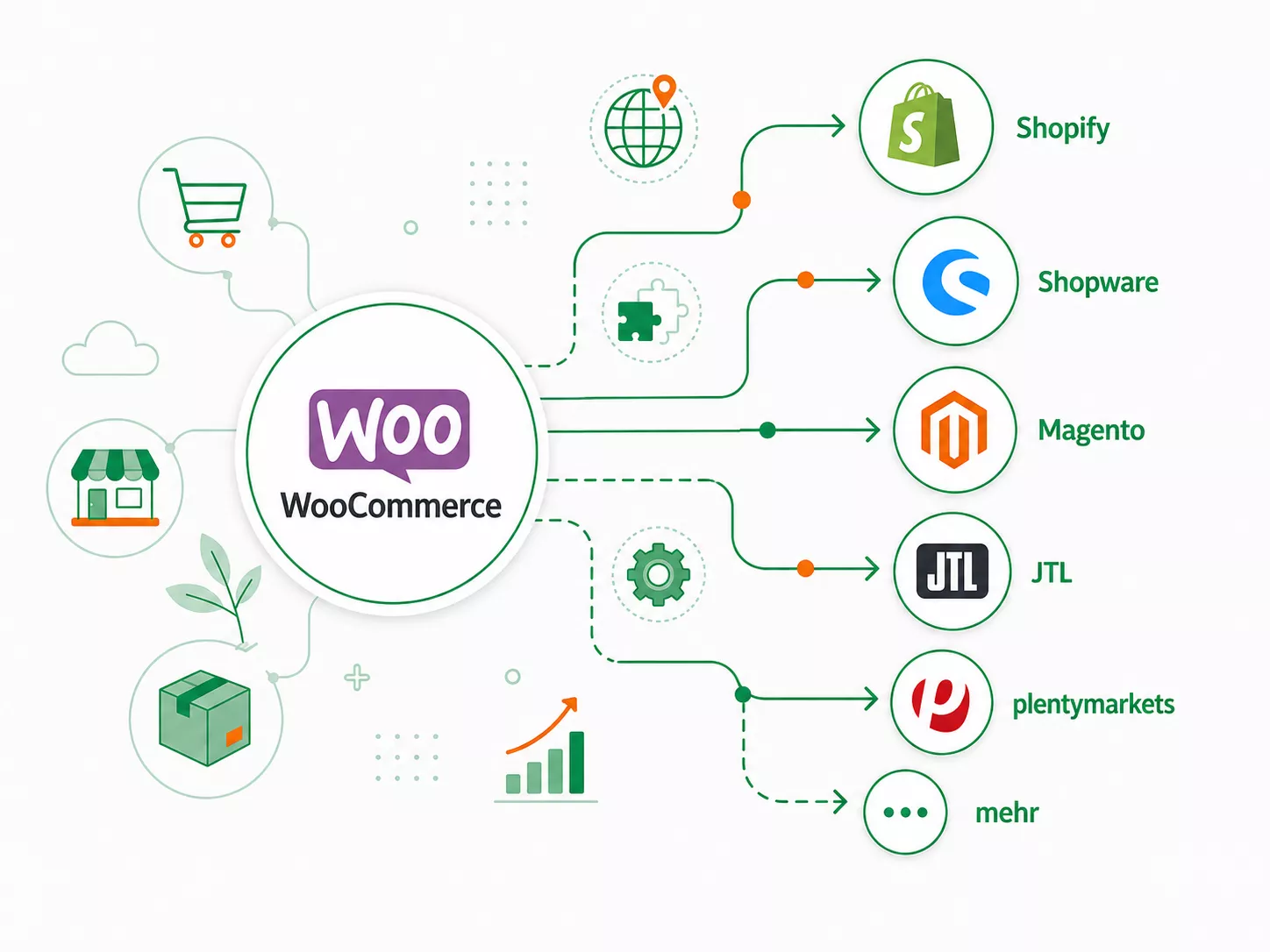
WooCommerce is free, flexible and runs on WordPress. You still pay, though, just in maintenance: updating plugins, watching for security gaps, handling hosting and performance yourself. At some point many merchants wonder whether the effort is still worth the price advantage.
The choice of alternatives is large, but not every one fits a WooCommerce shop. Let’s look at the best options: what they can do, where their limits are and which system really pays off for whom.
- • Shopify is the most obvious alternative for most WooCommerce shops: hosted, maintenance-free, from 36 euros a month and with a strong CMS plus blog.
- • Your content edge from WordPress isn't lost in the move, because Shopify brings a solid content system with it.
- • BigCommerce is the SaaS alternative with many native features, Squarespace the option for small design- and content-driven shops.
- • Adobe Commerce (Magento) is the exception: for very large, custom enterprise B2B, Shopify isn't automatically the best choice.
- • WooCommerce's strength stays the full control and content focus through WordPress. The price for it is the ongoing maintenance.
Why do merchants look for a WooCommerce alternative?
Most don’t switch because WooCommerce is bad, but because the ongoing effort gets too big. WooCommerce is a free, open-source plugin for WordPress and therefore self-hosted. That means operation, security and updates are on you.
Four reasons come up again and again in practice:
- Plugin sprawl: a plugin for every feature, and each one wants upkeep, updates and compatibility checks.
- Maintenance is your job: security gaps, WordPress updates and plugin conflicts stay your responsibility permanently.
- Performance at scale: with more traffic, caching and server tuning become your own topic, otherwise load times suffer. In our Core Web Vitals shop system study, only 45.6% of WooCommerce shops pass the mobile benchmark, against 81.8% of Shopify shops.
- Operating instead of selling: time that goes into tech is missing for growth, marketing and conversion.
The bottom line: the license is free, but the total operation of hosting, plugins and maintenance is anything but. That’s why a look at the alternatives is worth it.
The “free license” framing is what trips most WooCommerce merchants up. Before you compare any alternative, add up your hosting, plugin licenses and the developer hours you spend on updates and conflicts over a year. Nine times out of ten that real number reframes the whole decision, because the switch stops looking like a new cost and starts looking like trading one bill for a smaller, more predictable one.
What does a good WooCommerce alternative need?
A real alternative has to take maintenance off your plate without costing you your content edge. Judge every candidate on the same six criteria:
- Total cost: not just the license, but hosting, plugins, maintenance and support combined.
- Scalability: does the platform keep up with growth and traffic peaks without your own tuning?
- Ease of use: how much can you do yourself, without a developer?
- Maintenance: who handles updates, security and operations?
- Content and SEO: is the system enough for your content, and do your rankings survive the move?
- Time to market: how fast are you live and able to ship changes?
The comparisons below hang on this grid.
The best WooCommerce alternatives at a glance
WooCommerce spans a wide range, from the small content shop to the growing mid-market. The choice of sensible alternatives is just as broad:
| Platform | Type | From price/month | Hosting | Best for |
|---|---|---|---|---|
| Shopify | SaaS (hosted) | from 36 € | included | Maintenance-free, scalable shops with strong content |
| BigCommerce | SaaS (hosted) | from ~35 € | included | SaaS fans wanting many native features |
| Squarespace | SaaS (hosted) | from ~36 € | included | Small, design- and content-driven shops |
| Shopware | Self-hosted | CE free | your own | Growing B2B shops in the DACH mid-market |
| Adobe Commerce (Magento) | Self-hosted / PaaS | high license/year | your own | Very large, custom enterprise B2B |
Which one fits depends mostly on where you’re headed: stay lean and maintenance-free, or grow up into larger B2B.
The alternatives in detail
Shopify: the maintenance-free switch
Shopify is a SaaS platform: hosting, updates and security are included in the monthly price, with plans starting at 36 euros a month. That solves the biggest WooCommerce pains at once, without giving up your content focus.
Strengths:
- End plugin sprawl. In the closed Shopify ecosystem, the security and compatibility upkeep for many plugins disappears.
- Stable when growing. No caching and performance tuning at traffic peaks, the platform scales automatically.
- Less technical dependency. You ship standard changes yourself instead of filing a developer ticket for every little thing.
Where it has limits: on content, WordPress is traditionally the leader. But you don’t give up that edge, because Shopify brings a strong CMS including a blog, and metafields plus apps bring back the flexibility you’d miss.
For whom: most WooCommerce shops that want maintenance freedom, stability and predictable costs.
Before you switch, add up honestly what your plugins, hosting and developer hours cost per year. Our ecommerce platform calculator puts exactly that sum next to the Shopify costs.
BigCommerce: the SaaS alternative with many native features
BigCommerce is hosted like Shopify but brings many features natively that WooCommerce needs plugins for.
- Strength: many native features, strong B2B features, no maintenance load.
- Weakness: smaller app ecosystem and fewer themes than Shopify, less adoption in the DACH region.
- For whom: merchants who want SaaS and value many built-in features.
Squarespace: for small design- and content-driven shops
Squarespace is a hosted builder with a strong design and content focus. For small shops where the website is central, it’s a fair option.
- Strength: very simple, design-strong, Squarespace handles all maintenance.
- Weakness: limited ecommerce depth, quickly hits limits on catalog, B2B and automation.
- For whom: small, design- and content-driven shops with a manageable catalog. Anyone who wants to scale seriously is better off with Shopify.
Shopware: the step into larger B2B
Shopware is an API-first system, especially strong in mid-market B2B in the DACH region.
- Strength: highly customizable, full code control, strong for individual B2B requirements.
- Weakness: self-hosted with hosting costs and major upgrades as projects, you trade WooCommerce maintenance for Shopware operation.
- For whom: growing merchants with serious B2B needs and a technical team.
Adobe Commerce (Magento): the enterprise heavyweight
Adobe Commerce, formerly Magento, is the pick for very large, highly custom shops with complex B2B.
- Strength: maximum depth for individual enterprise processes and large B2B.
- Weakness: license, infrastructure and your own dev team quickly tie up high five-figure sums per year.
- For whom: corporations and large merchants with their own dev team. Shopify isn’t automatically the better choice here.
When should you stay on WooCommerce?
Not every shop has to switch. WooCommerce stays a good choice if your business runs strongly on content and WordPress and you have the technical know-how in house or at a reliable agency.
Concretely, staying makes sense if: you run a large WordPress site with a blog and editorial team anyway, you need maximum code control over every detail, or your catalog is small and stable so the maintenance effort stays manageable.
But as soon as plugin upkeep takes over, performance suffers at scale, or you spend more time on tech than on selling, switching is the better math. A good moment for the decision is an upcoming relaunch or a hosting change, because you’re touching everything anyway.
WooCommerce vs. Shopify: the direct comparison
For most, this is the deciding matchup. Here’s the short version:
| Criterion | WooCommerce | Shopify |
|---|---|---|
| Model | Self-hosted plugin for WordPress | SaaS, fully hosted |
| Entry cost | software free, but hosting and plugins | from 36 €/month, all included |
| Hosting and updates | your own, including security | included, automatic |
| Maintenance | high (plugins, updates, security) | minimal |
| Content and SEO | WordPress leads | strong CMS and blog |
| Scaling | with hosting and tuning, not automatic | automatic up to Shopify Plus |
| Time to market | many moving parts, takes time | live fast |
| Best for | content-driven WordPress shops with tech resources | maintenance-free, scaling brands |
Read the detailed head-to-head with all the cost, content and maintenance detail in Shopify vs. WooCommerce. For an overview of all common systems, see the ecommerce platform comparison.
Which alternative pays off for whom?
The right choice depends on your profile, not on a blanket winner.
| Your profile / requirement | Recommendation |
|---|---|
| Live fast, maintenance-free, predictable costs | Shopify |
| Small design and content shop, small catalog | Squarespace or Shopify |
| Keep a strong WordPress and blog focus | Shopify or stay on WooCommerce |
| Growing B2B in the DACH region | Shopware |
| Very large, custom enterprise B2B | Adobe Commerce |
For most WooCommerce shops the road leads to Shopify, because the balance of maintenance freedom, speed and content strength fits best.
What does switching from WooCommerce cost?
It depends on the size of your shop, the number of products, your plugins and the complexity of your content. So there’s no fixed flat price.
Two things help you gauge it. First, the ecommerce platform calculator, which shows what your current system costs across the whole operation. Second, our experience as an agency specialized in Shopify migration from over 45 moves: especially when migrating from WordPress, it’s crucial that content, URLs and rankings are carried over cleanly. How it works for WooCommerce is on our WooCommerce to Shopify migration page.
Clean redirects are a must, especially for content-heavy WooCommerce shops. Every old URL needs a matching target so the rankings you’ve built over years survive the move.
Conclusion: which WooCommerce alternative fits you?
For most WooCommerce shops, Shopify is the best alternative. Instead of maintaining plugins, watching for security gaps and managing hosting, you work on a stable, maintenance-free system. You don’t give up your WordPress content edge, because Shopify brings a strong CMS including a blog.
The exception: for very large, highly custom enterprise B2B, Adobe Commerce can be the better choice. And anyone who lives on WordPress anyway, runs a small catalog and has maintenance under control can deliberately stay on WooCommerce.
Not sure whether the switch pays off for your shop? We migrate your WooCommerce shop at a fixed price and make sure data and rankings survive the move. Get your free analysis.
 Frequently Asked Questions
 What is the best WooCommerce alternative?
Is Shopify better than WooCommerce?
Will I lose my SEO rankings when switching from WooCommerce?
Can I keep my WordPress blog after switching to Shopify?
What does switching from WooCommerce to Shopify cost?
You might also like
Volusion Alternatives 2026: Modern, Future-Proof and Conversion-Strong
Volusion alternatives compared: a modern, future-proof system with a strong checkout and active ecosystem instead of an outdated base. With a recommendation.
Webflow Alternatives 2026: The Shop Systems Actually Worth It
Webflow alternatives compared: real selling depth with subscriptions and more payment methods, while the strong design and CMS stay. With a recommendation.
Jimdo Alternatives 2026: The Strongest Alternatives Compared Head-to-Head
Jimdo alternatives compared: a real shop system with subscriptions, more payment methods and ERP integration instead of builder limits. With a recommendation.